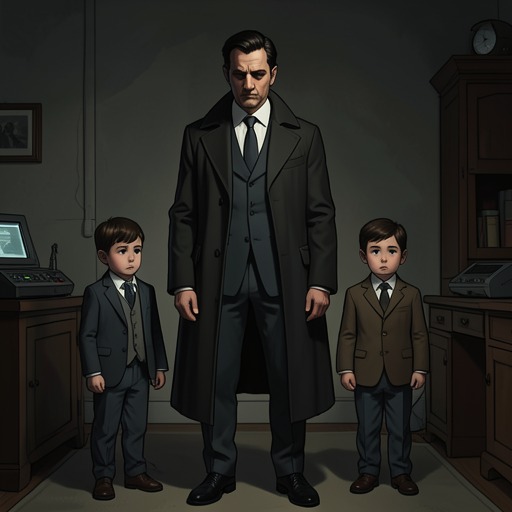
Emory Fields
Big BrotherEmory Fields, the idealistic father in Joint Custody, embodies the countercultural alternative to career-minded parenting even as the series exposes the limits of his ideals. His ecological convictions shape the life he offers his children, but his insistence on doing everything the hard way and his permissive parenting leave the family negotiating the consequences of competing households. Decades later, the show’s remembered theme song and its “caught squeezed in the middle” family geometry help the narrator recognize a conflict playing out in her own home.
Identity and Background
Joint Custody places Emory opposite Mimi Barnes, his former wife, who has left their hippie life, resumed her maiden name, and established herself as a family-law practitioner in Portland. He remains attached to the past the series calls countercultural: he builds and lives in a cabin in the Cascades without running water or electricity, uses an outhouse, and tries to grow organic vegetables, though the crops die. The contrast is not simply between two households but between competing ideas of what parents should prepare children to become.
The show’s premise was framed as a response to television’s reluctance to depict divorce. Its producers argued that children of separated parents deserved stories that took the difficulties of fractured families seriously. In retrospect, the narrator sees Joint Custody as a cultural conduit between the idealism of the 1960s and the pragmatism of the 1980s. Emory’s role belongs to that hinge: ecologically prescient in retrospect, but presented in scripts that were not especially sympathetic to his determination to avoid resource use and pollution at nearly any cost.
Parenting and Conflict
The children move between parents who dislike one another, with the legal custody arrangement making the practical work of changing households part of the family’s daily terrain. Mimi is authoritarian and prioritizes her children’s career prospects over their creative expression. Emory instead promotes countercultural fulfillment, but his permissiveness often gets the children into trouble. The show thus gives neither household an uncomplicated claim to wisdom: Mimi’s structure narrows the children’s possibilities, while Emory’s freedom can leave them exposed to consequences.
Mimi’s objection to Emory’s environmental absolutism crystallizes the conflict. She fears that his exclusive focus on avoiding consumption and pollution teaches the children that the highest ambition available to them is merely to do no harm. His principles are therefore both an ethical stance and a constraint: the series can recognize the seriousness of his concern while questioning the diminished horizon it seems to impose on his children.
Cultural Afterlife and Narrative Role
The narrator recalls the series through its theme song, which she and her brother sing together late at night. Its opening identifies Emory as “a right-on dad,” then immediately undercuts the praise by noting that his cool hippie manner is getting old and that flower power cannot heat his home. The lyric turns his countercultural identity into a compact comic contradiction: conviction may be admirable, but it does not provide practical comfort. The narrator treats the remembered song as one of the mental inscriptions likely to endure longest, making Emory’s fictional household a durable part of her own family memory.
That memory becomes a way of reading the narrator’s present. When her husband Fletcher enters the kitchen and interrupts her late-night time with her brother Edison, she recognizes an old social arrangement: as children, she and Edison would stop what they were doing when their father entered, then wait for him to leave. Now, she feels that she and Fletcher are supposed to be the pair who spend time together, while her closeness with Edison places her between brother and husband. The television series’ custody structure gives this divided allegiance a name and shape, without making the narrator’s household identical to Emory’s fictional family.
Relationships and Significance
Emory’s relationship with Mimi is defined by opposition over both lifestyle and parenting. Their differences structure the children’s experience of moving between homes, while the show’s title foregrounds the legal and emotional logistics of separation. The narrator’s later recollection of the series transfers that structure into a different kind of family tension: not a custody dispute, but the pressure of balancing a sibling bond with a marriage.
Emory also remains present in the novel through Edison’s attachment to the series and its cultural world. The narrator recalls Edison’s jazz-related bitterness as part of the afterlife of the character Caleb Fields, one of the show’s prodigious children, but Emory’s defining place in the remembered song is the father whose ideals are both mocked and made memorable. He functions less as a fully developed figure in the present-day action than as a cultural and familial reference point through which the narrator interprets idealism, parenting, and divided loyalties.